
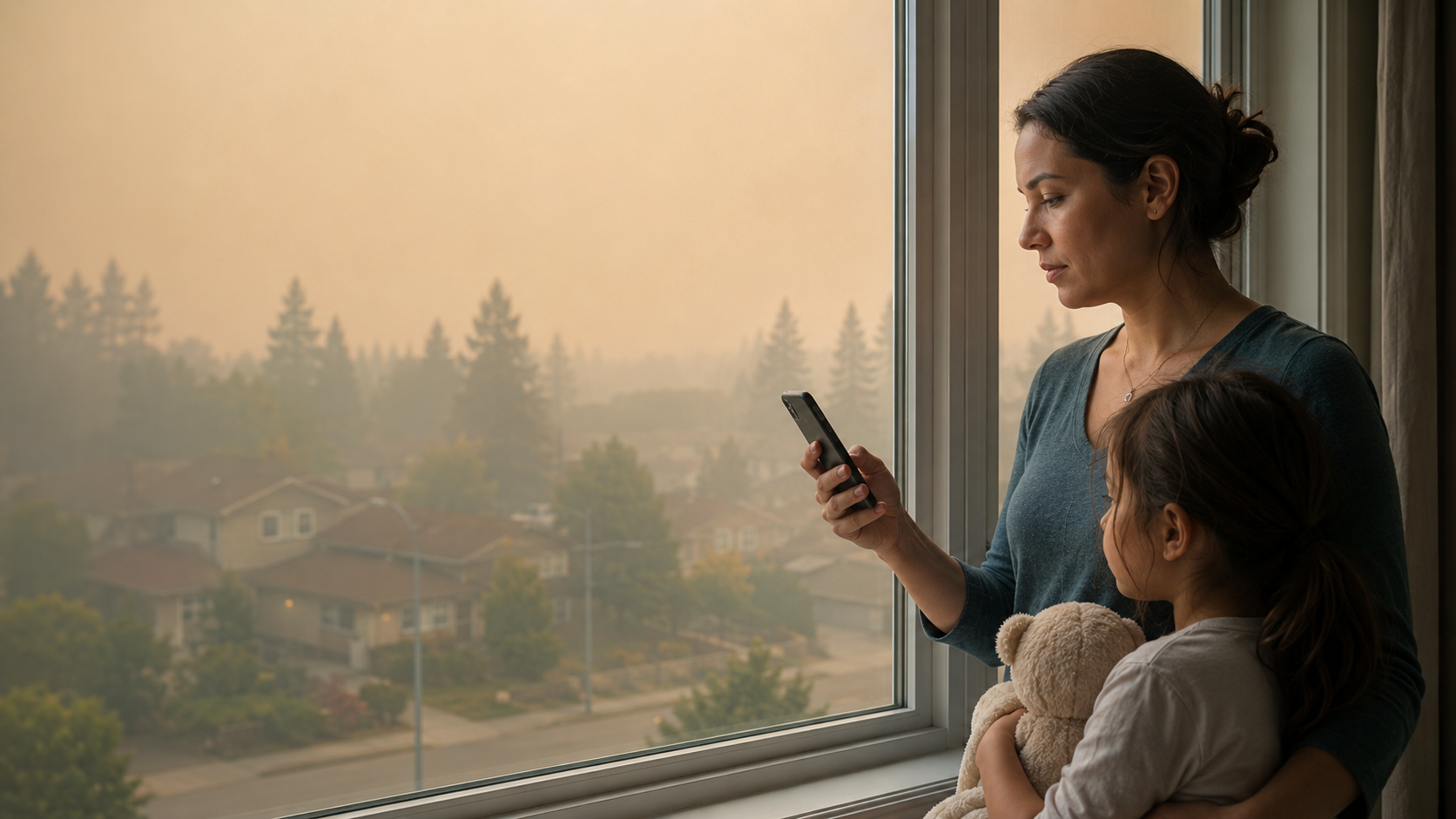
Wildfire smoke can travel hundreds or even thousands of kilometres. Air quality can deteriorate quickly even when there is no visible fire nearby. The best protection is to follow air-quality alerts and reduce the amount of smoke you breathe.
Why is wildfire smoke harmful?
Wildfire smoke contains gases and extremely small particles known as PM2.5. These particles are invisible to the eye, can travel deep into the lungs and represent the main health risk from smoke.
Exposure can irritate the eyes, nose and throat, trigger coughing, and worsen asthma or other lung disease. It can also stress the cardiovascular system and increase the risk of complications in people with heart disease.
Risk rises as smoke concentrations increase, exposure lasts longer and physical activity becomes more intense.
Who should take extra precautions?
People with asthma, chronic obstructive pulmonary disease, another lung condition, heart disease or diabetes.
Adults aged 65 and older, infants, young children and pregnant people.
People who work, exercise or spend long periods outdoors, and those who have limited access to cool, well-filtered indoor air.
During heavy smoke, anyone can develop symptoms, even without a known medical condition.
Check air quality before going outside
Check Québec’s air-quality index, the Air Quality Health Index (AQHI), weather advisories or the WeatherCAN app.
The AQHI uses a scale from 1 to 10+: 1 to 3 is low risk, 4 to 6 moderate, 7 to 10 high and 10+ very high. At 10+, everyone’s health may be affected.
Reduce or postpone strenuous outdoor activity when air quality is poor. People at higher risk should act sooner and stop activity if symptoms appear.
Create cleaner indoor air
Keep doors and windows closed while outdoor air is smoky, provided the indoor temperature remains safe. If your home becomes too hot, go to a cooler location with filtered air, such as a library, community centre or shopping mall.
Use air conditioning or a heat pump. Set air exchangers and vehicle ventilation to recirculation. For central systems, use the highest-quality filter the equipment can safely handle; a compatible MERV 13 or higher filter provides better fine-particle filtration.
A portable air cleaner with a HEPA filter can lower particle levels in the room where you spend the most time. Choose one sized for the room, run it long enough and replace filters as directed.
Avoid devices that produce ozone. Reduce indoor pollution from smoking, vaping, candles, incense, wood stoves, frying and vacuuming without adequate filtration.
Can a mask help?
If you must go outdoors, a well-fitted NIOSH-certified N95 respirator or equivalent can reduce your exposure to fine particles.
Facial hair commonly prevents a proper seal. Medical masks and cloth face coverings are much less effective against smoke. An N95 does not remove all gases in wildfire smoke and does not replace limiting exposure time.
Standard N95 respirators generally do not seal properly on young children. Cleaner indoor air and fewer outdoor activities are the main protective measures for them.
If you have lung or heart disease
Continue prescribed medications and keep rescue inhalers available. Do not wait until smoke arrives to renew important prescriptions.
Ask your physician or pharmacist for a clear plan: which symptoms to monitor, when to use rescue medication and when to seek care. Do not change medication doses on your own.
When should you get medical help?
Mild eye or throat irritation, a runny nose, headache or mild cough often improves after leaving the smoke. Go indoors, rest and monitor your symptoms.
A severe cough, wheezing, shortness of breath, dizziness or palpitations requires prompt medical advice. In Québec, you can call Info-Santé 811.
Call 9-1-1 for chest pain, severe breathing difficulty, confusion, loss of consciousness or symptoms suggesting a heart attack or stroke.
At Bina Clinic, we encourage patients with lung or heart disease to prepare before a smoke event. Reliable information, cleaner indoor air and timely action when symptoms appear can make a meaningful difference.
Official sources
- Gouvernement du Québec — Prévenir les effets sur la santé de l'exposition à la fumée de feux de forêt
- Government of Canada — Wildfire smoke: health effects of exposure
- Environment and Climate Change Canada — Wildfire smoke, air quality and your health
- Health Canada — Using a portable air cleaner to improve indoor air
This article provides general information and does not replace a personalized medical assessment, diagnosis or treatment.