Rapid strep tests and throat cultures use different methods to detect group A strep bacteria. Understanding these differences can help you choose the right appointment and understand your result. [3,4,5]
What happens next depends on your symptoms, health history and the type of test used.
If you have difficulty breathing or cannot swallow your saliva, call 911 or go to the nearest emergency department. For advice about a non-urgent concern, call Info-Santé 811, option 1. [1,7]
When should you consider a strep test?
A sudden sore throat accompanied by fever, painful swallowing, tender neck glands or swollen tonsils is a reason to seek an assessment. Children may also have stomach pain, nausea or vomiting. [1,2]
A cough, runny nose or hoarse voice points more toward a viral infection. When these signs are clear, a strep test usually is not needed. White patches on the tonsils do not confirm strep on their own. [2]
Québec’s June 2025 INESSS protocol considers several findings together, including fever, the absence of a cough, swollen or tender neck glands, the appearance of the tonsils and age. It applies to eligible people aged 3 and older whose sore throat has lasted less than nine days. Signs of scarlet fever, such as a sandpaper-like rash, also guide testing. An assessment may determine that a test is not needed. [4]
Québec recommends a consultation if symptoms begin after contact with someone who has strep or last more than 72 hours. You do not need to wait 72 hours if you are worried or your symptoms are getting worse. [1]
Signs that need prompt medical assessment
Do not wait for a routine screening appointment if you have any of these symptoms: [4,7]
- Severe pain on one side of the throat, a muffled voice or trouble opening your mouth
- Visible throat swelling, or swelling, pain or stiffness in the neck
- Difficulty drinking or eating, or repeated vomiting
- Fever accompanied by feeling very unwell, or rapidly worsening symptoms
- Unexplained small red or purple spots on the skin
- Blood in your urine
Seek medical assessment promptly. If you are unsure where to go, call 811 for guidance. For severe or potentially life-threatening symptoms, including difficulty breathing or an inability to swallow saliva, call 911. [7]
What happens during a strep test?
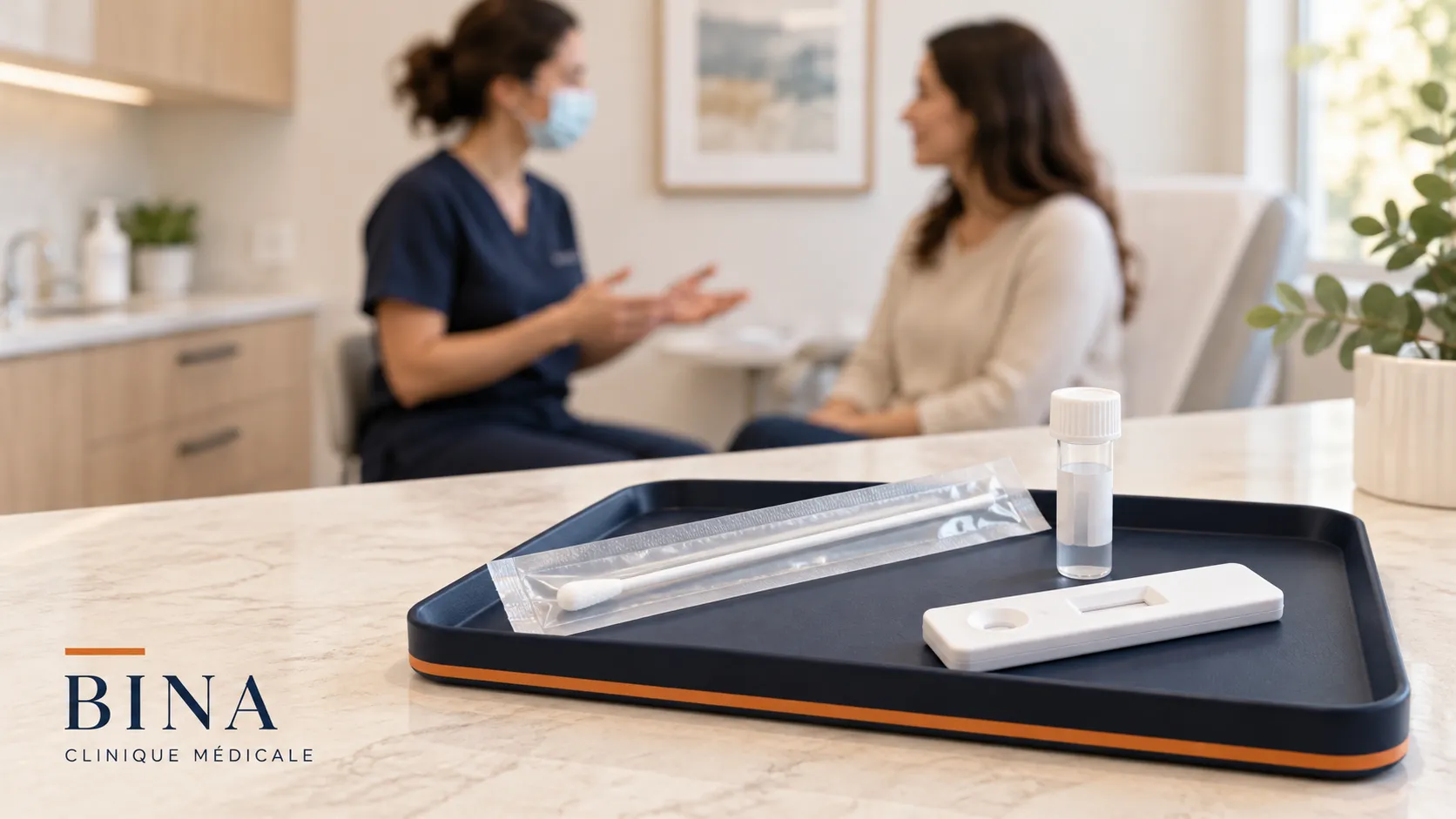
A healthcare professional rubs a swab over the back of your throat and your tonsils. This may briefly feel uncomfortable or make you gag. [3]
The time it takes to receive your result depends on the test and the service. Rapid antigen tests can provide results in about 10 to 20 minutes, while a laboratory throat culture can take 24 to 48 hours. Your visit may last longer than the test itself. [3]
Before you leave, ask which test was used, when you will receive the result and how any further care will be arranged.
Rapid strep test or throat culture: what is the difference?
Rapid tests can use different methods. Québec’s protocol includes antigen tests, molecular tests and throat cultures. A molecular test may be called a NAAT, which stands for nucleic acid amplification test. Availability varies by service. [4]
Rapid antigen test
This test detects substances from group A strep bacteria. It can miss an infection, so a negative result sometimes needs to be followed by a throat culture. [3,4,5]
Rapid molecular test
This test detects genetic material from group A strep bacteria. The follow-up culture rule for antigen tests, explained below, does not automatically apply to molecular tests. Medical follow-up may still be needed. [4]
Throat culture
A throat culture checks whether group A strep bacteria grow from the sample in a laboratory. It takes longer than a rapid antigen test and can detect infections that an antigen test misses. [3,5]
What does a positive or negative result mean?
A positive result
When symptoms are consistent with strep throat, a positive result usually supports the diagnosis. A healthcare professional generally recommends antibiotics. These reduce the risk of complications and transmission and can shorten symptoms by about a day. Take any antibiotic exactly as prescribed. [1,5]
Stay home to reduce the chance of spreading the infection. Québec’s protocol allows children to return to school or daycare after 24 hours of treatment, depending on their general condition. Follow the advice given for your child. [4]
If there is no improvement after 48 to 72 hours of treatment, seek reassessment. Get help sooner if symptoms worsen or warning signs appear. [4,7]
Some people carry group A strep bacteria without becoming ill from them. A carrier who develops a viral sore throat can still test positive, so the result needs to be considered alongside the symptoms and clinical assessment. [5]
A negative result
A negative rapid antigen test can miss strep. It does not establish another cause for your symptoms. [2,5]
For people eligible under Québec’s June 2025 protocol, a follow-up throat culture after a negative antigen test is specified for: [4]
- Children aged 3 to 14
- People with a previous complication of group A strep, such as rheumatic fever
- People living in an Indigenous community
This culture rule specifically concerns antigen tests. If you had a molecular test, ask what follow-up your result requires. [4]
A separate rule concerns medical assessment: under the same protocol, a negative result still requires a medical consultation during pregnancy, for a transplant recipient taking immunosuppressants, or when there are signs of scarlet fever. This instruction is not limited to antigen tests. [4]
If a sample was sent for a culture, confirm how and when you will receive the result. Contact a healthcare professional if symptoms persist or worsen, even after a negative test.
Where can you get tested in Québec?
Certain public local service points offer group A strep testing. Book through Clic Santé under Screening, then Streptococcus A screening. An assessment helps determine whether testing is appropriate. [1,4]
Some community pharmacies also offer strep testing. Check which services are available and whether you are eligible with the pharmacy. [9]
At Bina Medical Clinic in Brossard, choose the appointment that fits your needs.
Rapid strep test only
The booking option is “Rapid Test (Strep, COVID-19, Influenza).” The nursing team collects the sample, runs the test on site and gives you the result. Diagnosis, prescriptions and treatment are separate.
See rapid strep testing in Brossard for current details and fees. [6]
Nurse-led visit for a recent sore throat
The nurse assesses an eligible, isolated sore throat and determines whether testing or a physician’s assessment is needed. Testing and physician assessments are charged separately when applicable.
See nurse-led consultation for details. [7]
Consultation with a doctor
Choose this option if you need a physician to assess your sore throat, including advice about diagnosis or treatment. Testing and sample collection are charged separately. A throat swab requires an in-person visit.
See consultation with a doctor for details. [6,8]
If your sore throat keeps returning or you have other medical concerns, contact the clinic before booking. [7]
Common questions
Do I need a prescription for a rapid strep test at Bina?
No. Bina’s rapid screening tests do not require a physician’s prescription. The screening appointment does not include a diagnosis or treatment. [6]
Can I book a strep test for my child?
Contact Bina before booking to confirm the appropriate service and your child’s eligibility. Strep throat is uncommon in children under age 3, and Québec’s protocol applies from age 3. [2,4,6]
My test was negative, but my throat still hurts. What now?
Follow the advice given with your result and ask whether a culture or reassessment is needed. Seek care sooner if symptoms worsen. If you have difficulty breathing or cannot swallow your saliva, call 911 or go to the nearest emergency department. [4,7]
Not sure which visit you need?
Call Bina Medical Clinic at 514-307-0111 for help choosing a visit.
Review the Screening Tests, Nurse-led Consultation and Consultation with a Doctor pages for current details and fees.
Official sources
- Gouvernement du Québec: Streptococcal A pharyngitis or tonsillitis
- CDC: Clinical Guidance for Group A Streptococcal Pharyngitis
- MedlinePlus: Strep A Test
- INESSS: Protocole médical national, pharyngite-amygdalite, June 2025 (in French)
- CDC: Testing for Strep Throat or Scarlet Fever
- Bina Medical Clinic: Screening Tests
- Bina Medical Clinic: Nurse-led Consultation
- Bina Medical Clinic: Consultation with a Doctor
- INESSS: Pharyngite-amygdalite bactérienne, protocol overview (in French)
This article provides general information and does not replace a personalized medical assessment, diagnosis or treatment.